

Music cognition research has traditionally focused on developing normative accounts of music perception: how does the average (read: Western, industrialised, educated) listener respond to music? However, this approach disguises the fact that the listening experience can drastically vary between listeners, especially (but not exclusively) if they come from distant cultures.
This variation is interesting for several reasons. Firstly, it can help us deconstruct a given cognitive phenomenon into its underlying processes (e.g. deconstructing consonance into roughness and harmonicity). Second, it can help us to understand the origins of these cognitive phenomena: those that are constant across the world are likely to be biologically hardwired, whereas those that vary are likely to be driven by learning. Third, it can help us to understand our own music preferences and how they relate to others.
Projects in this area could draw on any of the topics mentioned in Computational music cognition. We would recommend starting with a theoretical review to identify what dimensions of individual differences are likely to exist, and using this to develop a rigorous test battery for quantifying those individual differences. We can then run online experiments using our platform PsyNet to test participants across the world, and see how the individual differences vary as a function of culture and other person-level variables. The results can then potentially be linked to corpus analyses of musical cultures across the world.
Related projects
Related publications
- What music do people use for mood regulation? Psychology of Music (2026)
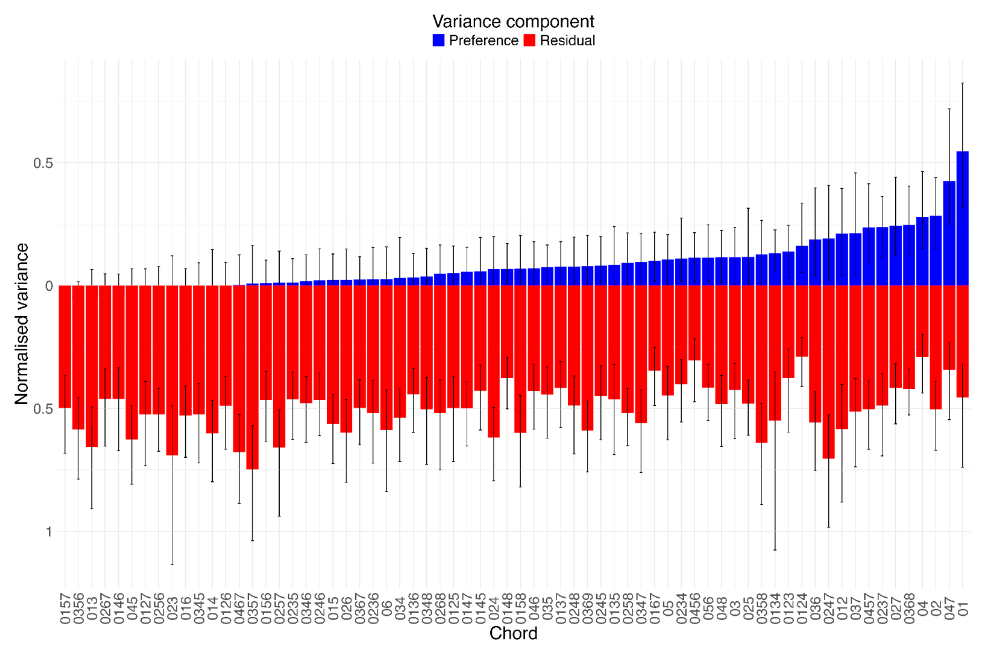
- Modeling individual differences in chord pleasantness judgments Psychology of Aesthetics, Creativity, and the Arts (2026)
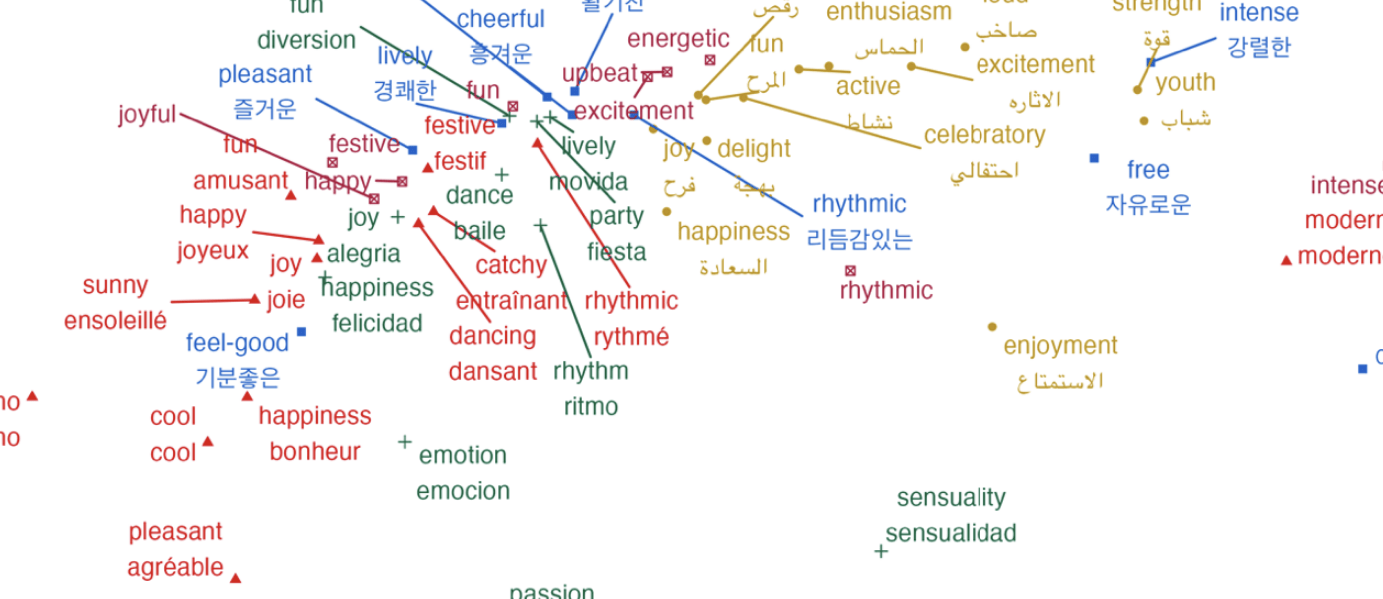
- GlobalMood: A cross-cultural benchmark for music emotion recognition International Society for Music Information Retrieval Conference (2025)
- Consonance in the carillon Journal of the Acoustical Society of America (2024)
- Timbral effects on consonance disentangle psychoacoustic mechanisms and suggest perceptual origins for musical scales Nature Communications (2024)