
The goal of computational music cognition research is to develop computer models that simulate how humans engage with music. These models help us better understand both the psychology of music and the origins of musical styles. They also often have interesting practical applications, helping us to develop software tools for analysing and creating music.
Such models mostly draw on four kinds of approaches. Psychoacoustic models focus on the physics of the sound itself, modelling how it is transformed by the peripheral auditory system and received by the brain. Dynamic systems models study the emergent behaviour of interconnected basic components (e.g. neuronal oscillators) when they are driven by external stimuli. Probabilistic models treat the human as a rational observer, one who constantly learns patterns from the music they hear, and generates predictions such as “what might happen next”, “what is the underlying communicative intent”, etc. Music-theoretic models meanwhile instantiate formal principles that scholars have derived about particular musical styles, under the assumption that sophisticated listeners will have themselves internalised versions of these principles.
Such models can profitably be applied to a huge number of areas in music cognition, for example similarity, tonality, melody, emotion, semantics, expectation, tension, syntax, rhythm, pleasure and groove, consonance, auditory scene analysis, imagery, composition, improvisation, interpretation, coordination, singing, dancing, and motor learning. More progress has been made in some of these areas over others, but each still has much scope for further exploration.
At the CMS we have pioneered research in several of these music cognition topics, including both perceptual topics (melody, consonance, emotion, pleasure) and production topics (interpretation, coordination). We welcome new research projects within or outside these topic areas.
Here is a generic blueprint for a PhD-scale computational music cognition project; an MPhil project could comprise a subset of these steps.
- Choose a domain to study (e.g. music similarity).
- Review existing psychological theories for the chosen domain.
- Review existing computational models for that domain, and compile usable implementations for these models.
- Compile relevant existing open-access behavioural datasets that could plausibly be used for model testing.
- Benchmark existing models against the existing data, and identify strengths and weaknesses of the models as well as gaps in the behavioural data coverage.
- Propose and conduct new behavioural experiments to fill these gaps, and/or propose new theories / computational models to improve on previous work.
- Repeat the benchmarking process, and iterate as appropriate.
Related projects
Related publications
- Computational Features for Symbolic Melody Analysis arXiv (2026)
- What music do people use for mood regulation? Psychology of Music (2026)
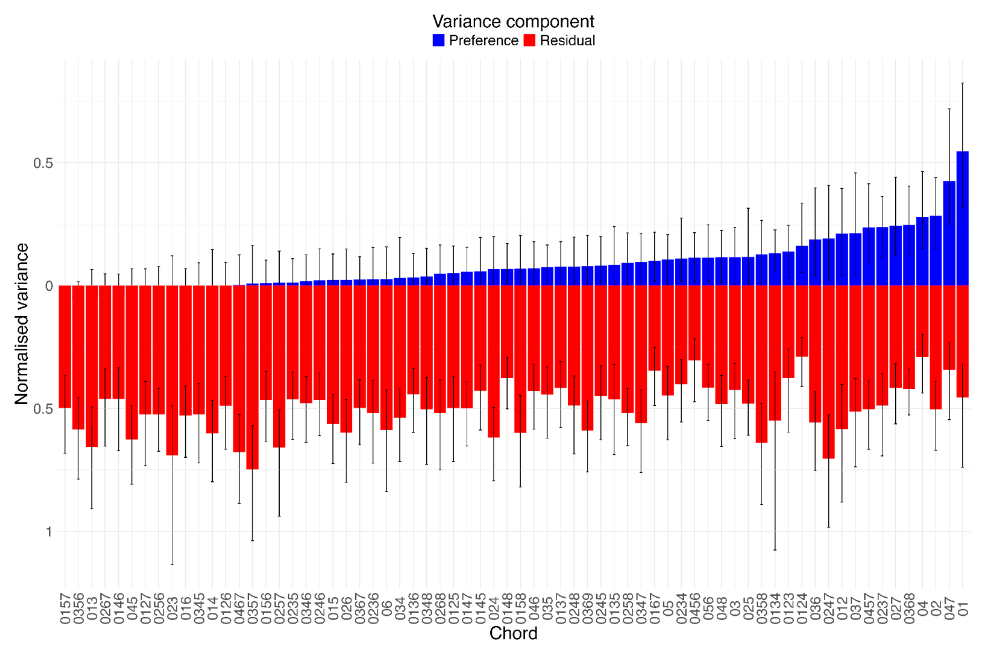
- Modeling individual differences in chord pleasantness judgments Psychology of Aesthetics, Creativity, and the Arts (2026)
- The recall and recognition of sonic logos Psychology of Aesthetics, Creativity, and the Arts (2026)
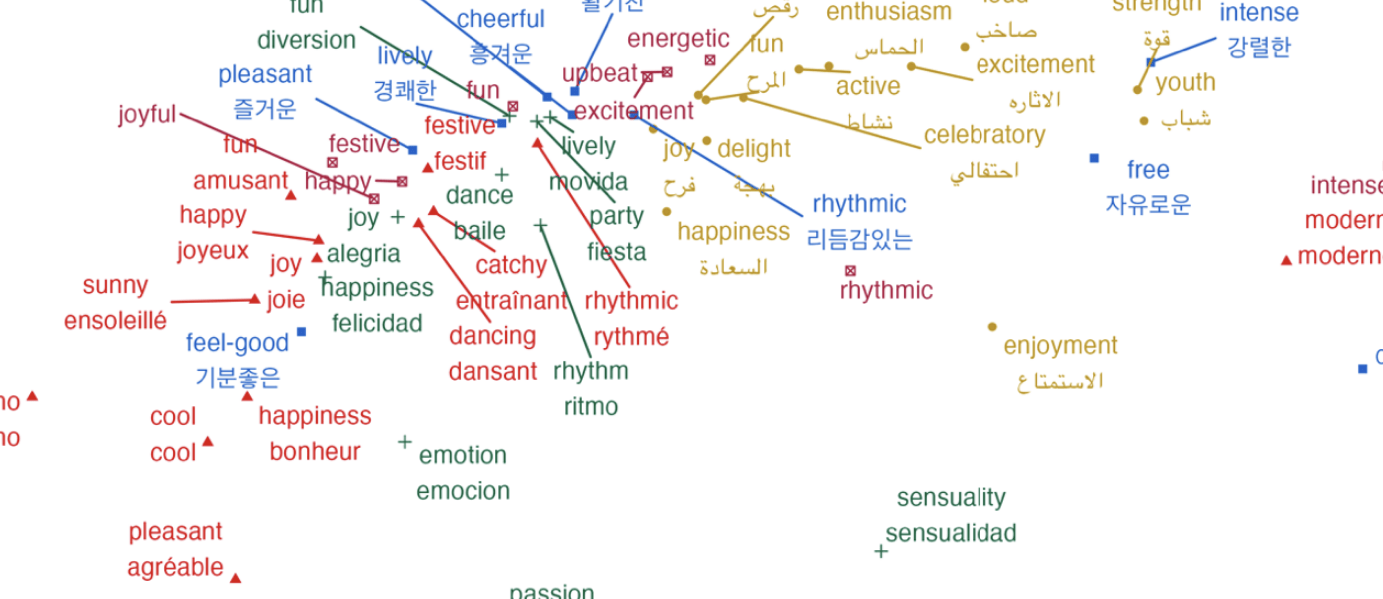
- GlobalMood: A cross-cultural benchmark for music emotion recognition International Society for Music Information Retrieval Conference (2025)
- Cognitive and sensory expectations independently shape musical expectancy and pleasure Philosophical Transactions of the Royal Society of London. Series B, Biological Sciences (2024)
- Consonance in the carillon Journal of the Acoustical Society of America (2024)
- Timbral effects on consonance disentangle psychoacoustic mechanisms and suggest perceptual origins for musical scales Nature Communications (2024)
- PPM-Decay: A computational model of auditory prediction with memory decay PLoS Computational Biology (2020)
- Uncertainty and surprise jointly predict musical pleasure and amygdala, hippocampus, and auditory cortex activity Current Biology (2019)