
2026 SEMPRE PGR/ECR Conference report
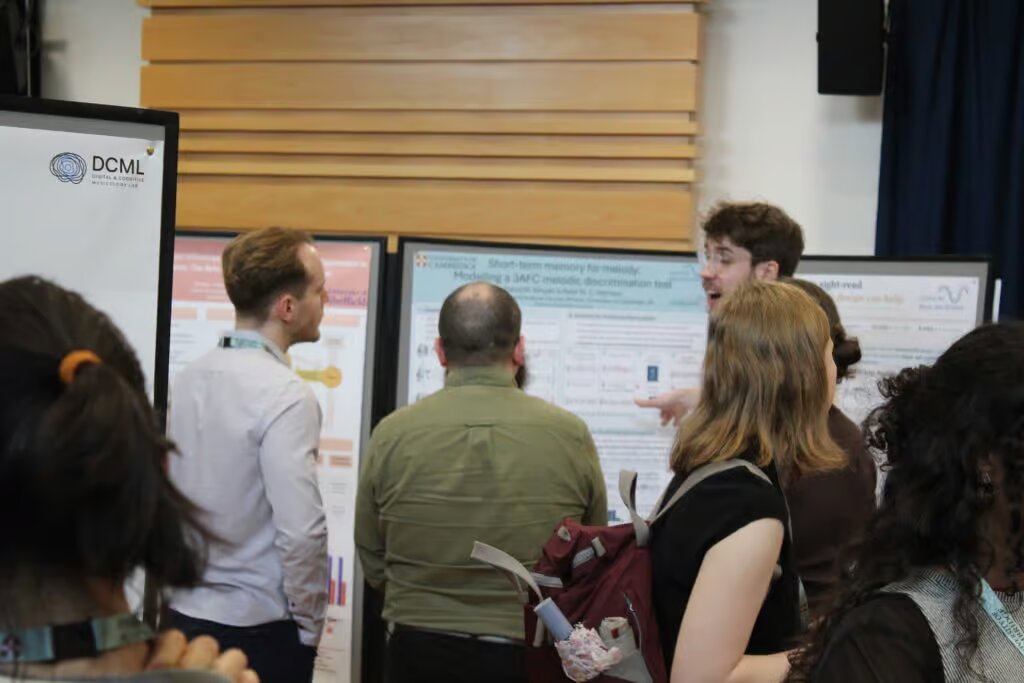
The 2026 Conference of the Society for Education, Music and Psychology Research (SEMPRE) was held at the Faculty of Music, University of Cambridge, on Thursday, 16 April. Co-hosted by Cambridge’s Centre for Music and Science and the Music, Mind and Brain group at Goldsmiths, University of London, the event showcased the work of postgraduate and early career researchers across music psychology and music education. More than 200 delegates attended, with 140 in person and 64 online, and the programme featured 111 poster presentations, 27 of whom were selected as Spotlight presentations. The event also coincided with the 60th anniversary of SEMPRE’s first conference, a milestone reflecting the Society’s continued commitment to supporting emerging scholars and fostering interdisciplinary exchange across music, education, and psychology.
The conference was led by steering committee members Peter Harrison, Diana Omigie, Ian Cross, and Manuel Anglada-Tort, with administrative support from Xi Zhang, supervisory support from Harin Lee, and assistance from student helpers Lena Alfter, Katelyn Emerson, Joshua Frank, Farshad Jafari, Lok Yan Lam, Safiyyah Nawaz, Katya Ness, Freya Prince, and David Whyatt. SEMPRE’s financial support, including travel awards, helped widen participation, while catering and social activities provided by Boxed Events supported a lively and collegial atmosphere. Presentation prizes were awarded to Ioanna Zioga for “Creative Music Improvisation Facilitates Performer-Listener Emotional Alignment and Cardiac Synchronization” and Lucas Klein for “Developing a Data-Driven Survey Measure of Musical Group Flow”, following review by Diana Omigie, Ian Cross, Marcus Pearce, and Nikki Moran.
The conference was run as a hybrid event, with attendees participating both in person and online. To support meaningful exchange across both modes of attendance, Slack served as the central platform for the day, used to share live updates, host discussion threads for posters, and streaming links for the Welcome, Keynote, and talk sessions. The whole day could not have taken place without SEMPRE’s substantial financial contributions and work reviewing and processing travel awards to support attendees from a wide range of research and geographic backgrounds.
Keynote
The keynote was delivered by Marcus Pearce (Reader in Cognitive Science, Queen Mary University of London), who opened with a deceptively simple question: if music is a universal human capacity, why do large-scale theories of music perception do so little to account for cultural difference? His address made the case that the field has leaned too heavily on universal principles, sidelining the role of lifelong cultural learning in shaping how we hear and enjoy music. At the heart of his alternative framework is the idea that listening is fundamentally predictive, with the brain constantly anticipating what comes next through expectations built from a lifetime of exposure to the musical patterns of a particular culture.
This emphasis on culturally learned listening was grounded in Pearce’s broader claim that musical experience develops through statistical learning, by which listeners internalise the regularities of the music around them, and probabilistic prediction, through which these internalised structures shape expectation, perception, and response. By presenting his probabilistic model of music, IDyOM (Information Dynamics of Music), as a computational implementation of these mechanisms, he showed how listeners acquire internal models of musical structure through experience, allowing the model to account for melodic, harmonic and rhythmic perception, thematic recognition, perceived complexity, and musical pleasure through measures such as information content and entropy. His broader argument was that musical appreciation is not a fixed or universal response, but an experience-dependent process shaped by enculturation, cultural evolution, and cross-cultural distance, through which changing musical traditions continuously reshape the expectations and perceptions of their listeners.
Themes across the programme
The range of work presented across the talk and poster sessions reflected how broad the field has become, spanning cognitive science, clinical research, education, and more applied topics. Wellbeing was perhaps the most prominent thread running through the conference, appearing across a wide range of contexts from clinical populations, including those with dementia, Parkinson’s disease, and psychosis, to community settings such as choirs for people experiencing homelessness, music programmes in prisons, and musical engagement following bereavement. Closely related was a recurring interest in music as a social and relational experience, with a number of presentations examining ensemble synchronisation, group flow, choral singing, and the prosocial effects of musical participation, rather than focusing solely on individual experience.
Music cognition and perception was a further substantial area, with work addressing rhythm, pitch expectation, tension, complexity, and memory through both behavioural and computational methods. Several papers on rhythm and entrainment took a cross-cultural angle, part of a broader pattern across the programme of pushing beyond Western musical traditions, as visible in work spanning North Indian classical music, Chinese and Malaysian pedagogical contexts, Hawaiian ukulele teaching, and Serbian protest songs.
Artificial intelligence and computational modelling appeared across a number of presentations, ranging from technical work on modelling musical expectation to questions about how listeners experience music they know to have been generated by an algorithm. Finally, a small cluster of work on sonic branding and everyday commercial listening contexts pointed to a growing interest in industry-facing research questions across the discipline.
Overall, the 2026 SEMPRE PGR/ECR Conference brought together an impressive range of early career work, and the breadth of the programme was itself telling, reflecting a field that is actively expanding its methods, its cultural scope, and the kinds of questions it considers worth asking. The strong attendance, enthusiastic engagement, and sense of community throughout the day underscored SEMPRE’s ongoing role in nurturing early career scholarship and building connections across an increasingly vibrant field. Next year’s conference date and location will be announced in due course.